For years, ecommerce has revolved around one clear obsession: reducing friction. Better checkouts, more accurate recommendations, fewer steps to payment. But something deeper is starting to change.
Artificial intelligence is no longer satisfied with helping you choose — it’s beginning to act on your behalf.
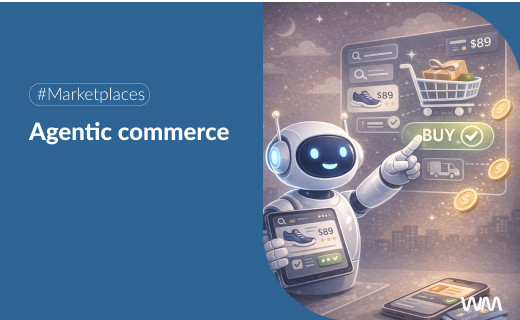
This is where agentic commerce comes into play, a concept that marks a turning point in how we understand digital commerce. We’re not talking about a new product filter or a friendlier chatbot. We’re talking about AI agents capable of discovering, comparing, and purchasing products autonomously on behalf of the user.
The “digital shopper” no longer clicks.
They delegate entire tasks.
What exactly is agentic commerce?
Agentic commerce is an ecommerce model in which intelligent agents operate autonomously, following goals and rules defined by the user. These agents don’t just suggest options — they make decisions and execute actions, including completing purchases.
In practice, this means an AI can handle the entire process: identifying a need, searching for options, comparing prices and conditions, and closing the transaction without the user having to intervene step by step.
This approach has been defined and analyzed by major players in the technology and payments ecosystem, all converging on one key idea: AI stops being a passive assistant and becomes an active participant in commerce.
From optimizing ecommerce to delegating it
Until now, artificial intelligence in ecommerce has mainly been used to improve specific parts of the user journey: homepage personalization, recommendation engines, automated customer support.
Agentic commerce changes the logic entirely. It no longer optimizes the user’s path — it reduces the need for the user to walk the path at all.
The value is no longer measured by how many clicks a person makes, but by how much they trust the system to act for them. Users define preferences, limits, and goals — price, favorite brands, sustainability criteria, purchase frequency — and the agent takes care of the rest.
Why now: the technology is ready
This trend didn’t emerge by chance. It aligns with three key developments.
First, the maturity of generative AI models, now capable of reasoning, planning, and executing complex tasks.
Second, the standardization of APIs and digital payment systems, which allow agents to interact securely with stores and platforms.
And third, a shift in consumer behavior, with people becoming increasingly comfortable delegating routine decisions to intelligent systems.
The result is a scenario in which purchasing stops being a one-off action and becomes a continuous, automated, and contextual process.
The clearest use case: everyday purchases
Where agentic commerce shows its greatest value today is in simple, recurring products. Grocery shopping is the perfect example.
Vegetables, fruit, basic household items, cleaning products. Emotional differentiation here is low, and the real value lies in saving time. An AI agent can learn consumption patterns, anticipate when products will run out, and place optimized orders based on price, availability, or delivery times.
For many households, this kind of delegated purchasing is not a threat — it’s a relief.
What about complex products like fashion?
This is where more questions arise — and also more opportunities.
Fashion is a deeply subjective category: style, fit, context, trends. Yet for precisely that reason, the potential of agentic commerce is enormous.
As AI agents integrate more signals — purchase history, returns, aesthetic preferences, occasions of use — they can filter out noise and narrow choices down to options that are truly relevant for each individual.
The goal isn’t for AI to impose decisions, but to reduce the field and, over time, earn enough trust to execute purchases with a high degree of accuracy.
A new landscape for brands and retailers
Agentic commerce doesn’t just change the consumer experience. It rewrites the rules for brands.
In a world where AI agents become the new intermediaries, it’s no longer enough to appeal only to the end user. Brands must also be understandable to machines. That means structured catalogs, clear data, transparent policies, and systems that automated agents can easily access.
Visibility will depend less on traditional SEO or advertising alone, and more on how agents evaluate value, reliability, and convenience.
So… will shopping agents become common in most households?
All signs point to yes — but gradually.
Just as we now delegate navigation to Google Maps or recommendations to streaming platforms, we will delegate routine purchases to AI agents. Agentic commerce doesn’t eliminate the consumer; it redefines their role.
Clicks give way to delegation.
Search gives way to intent.
Purchasing gives way to automation.
Frequently asked questions about agentic commerce
What’s the difference between agentic commerce and traditional ecommerce?
The key difference is that in agentic commerce, AI completes the entire purchase on behalf of the user, whereas in traditional ecommerce the user manually makes every decision.
Is it safe to let an AI buy things for me?
Security depends on permission systems, controls, and payment infrastructure. Current implementations rely on user-defined limits and advanced data protection standards.
When will it become mainstream?
Recurring, simple purchases are already the first step. For more complex products, adoption will be gradual — but everything suggests it will become increasingly common in the coming years.
Conclusion
Agentic commerce isn’t a passing trend or just another buzzword in the AI ecosystem. It represents a structural shift in how we buy, sell, and understand digital commerce.