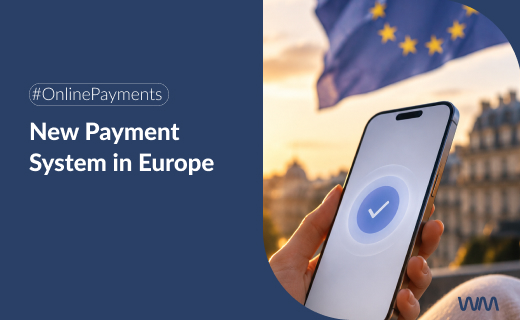
Europe is taking another step towards a more connected payments ecosystem.
Bizum, Bancomat, SIBS-MB WAY, Vipps MobilePay and EPI, the organisation behind Wero, have signed an agreement to advance the interoperability of some of Europe’s leading payment solutions.
The goal is ambitious: to enable consumers and merchants to make and receive cross-border payments across Europe using the payment solutions they already know and use in their local markets.
The initiative currently brings together solutions used by around 130 million people and is expected to cover 13 European countries.
But what does this interoperability actually mean, and what could it mean for the future of online payments in Europe?
From local payment methods to a European network
Europe’s digital payments landscape has one defining characteristic: many countries have highly adopted local payment solutions.
Spain has Bizum. Portugal has MB WAY. Italy has Bancomat, while Vipps MobilePay operates across the Nordic countries. They are joined by Wero, developed by the European Payments Initiative (EPI).
The strategy is not about replacing these solutions with a single European app.
Quite the opposite.
Bizum will remain Bizum, and MB WAY will remain MB WAY. Each solution will retain its own brand, features and user experience.
The innovation will happen behind the scenes.
The participating companies aim to develop a central interoperability hub that acts as a technical layer between the different solutions, allowing transactions to flow seamlessly across them.
The result could be an ecosystem where consumers can continue using their preferred payment method even when making transactions outside their home market.
Interoperability is already underway
This future is not starting from scratch.
Bizum, Bancomat and MB WAY have already made progress in connecting their respective systems through EuroPA, the European Payments Alliance.
This interoperability enables cross-border P2P payments between users in Spain, Andorra, Italy and Portugal using just a phone number and their usual payment solution.
The next step is to significantly expand this network.
The new collaboration brings additional European players into the ecosystem and sets out a two-phase roadmap:
- 2026: expansion of cross-border P2P payments.
- 2027: rollout of interoperability for ecommerce and point-of-sale (POS) payments.
It is this second phase that could have the greatest implications for merchants, marketplaces and businesses selling across multiple European markets.
What could this mean for European ecommerce?
For an international ecommerce business, accepting payments across different countries means understanding the preferences of each local market.
A Spanish consumer may be used to paying with Bizum, while a Portuguese consumer may prefer MB WAY. Across Europe, payment habits and preferred solutions vary significantly from one market to another.
Interoperability introduces a different possibility: preserving the local payment experience while giving the underlying payment infrastructure European reach.
This could be particularly relevant for businesses selling internationally.
Offering familiar payment methods can help reduce friction at checkout and allow businesses to adapt the payment experience to each market without requiring consumers to adopt a completely new solution.
For marketplaces and ecommerce businesses operating internationally, greater interoperability could also pave the way for a more connected European payments infrastructure.
Instant and account-to-account payments: another key part of the picture
The initiative also reflects a broader trend across the payments industry: the growth of instant account-to-account (A2A) payments.
The proposed interoperability model will be supported by European standards and infrastructure and will include this type of payment.
Rather than building a single solution for the whole of Europe from scratch, the approach is to connect payment methods and infrastructure that already have millions of users.
This makes it possible to preserve the trust and recognition of established local brands while extending their reach across borders.
130 million users across 13 countries
The initial scale of the project is significant.
Together, the payment solutions participating in the initiative serve approximately 130 million users.
At launch, the project is expected to cover 13 European countries, representing around 72% of the combined population of the European Union and Norway.
The initiative will also remain open to additional European markets.
Countries that already have a domestic payment solution will be able to connect it to the network, while markets without their own infrastructure could adopt one of the participating solutions.
The ultimate goal is to move towards a pan-European payment experience without losing the diversity that currently defines the market.
2027 could be a key year for online payments in Europe
Interoperability between European payment solutions is still being developed, and its rollout will be gradual.
However, the roadmap makes 2027 a particularly important year for ecommerce.
That is when the model is expected to expand to online purchases and in-store payments.
If the initiative progresses as planned, consumers could use their preferred payment solution across a much wider range of European merchants, while businesses could reach customers in different markets through interoperable payment infrastructure.
Europe does not necessarily appear to be moving towards a single European payment method. Instead, it is moving towards something different: a network in which different payment solutions can work together.
For ecommerce businesses, marketplaces and payment service providers, this development reinforces a trend that is already reshaping the industry: delivering increasingly local consumer experiences through increasingly connected infrastructure.
At Wannme, we closely follow the evolution of payment methods and the new infrastructure shaping the future of digital payments in Europe.
Because the more connected European ecommerce becomes, the more important it is for businesses to offer customers the payment methods they already know, use and trust.
Want to offer Bizum and MB WAY to your customers? Discover our solution