Shopping on Amazon is easy. With just a few clicks, you can have a product delivered to your door and, if it doesn’t meet your expectations, request a return. But what happens to that product afterwards? Is it sold again? Who pays for return shipping? And what costs does the seller have to cover?
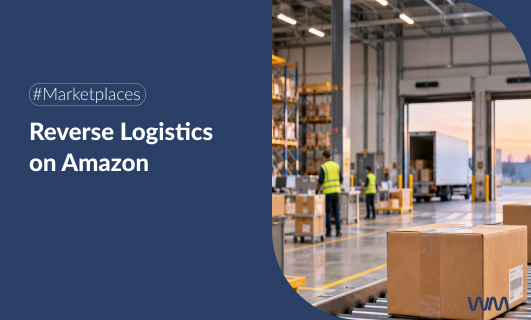
Behind every return is a process involving transportation, inspection and product recovery known as reverse logistics on Amazon.
For shoppers, this system makes returns and refunds more convenient. For sellers, however, it presents operational and financial challenges that can directly affect business profitability.
This is particularly relevant in industries such as fashion. According to the European Environment Agency, approximately 20% of clothing and 30% of footwear purchased online in Europe is returned. Although these figures refer to European ecommerce as a whole rather than Amazon specifically, they highlight the scale of an issue affecting the entire supply chain.
In this article, we explain how reverse logistics works on Amazon, what rights buyers have, who covers the costs and what options are available to recover the value of returned products.
What Is Reverse Logistics on Amazon?
Reverse logistics covers all the operations involved in handling a product that is returned after purchase.
While traditional logistics focuses on storing, preparing and delivering orders, reverse logistics manages the journey in the opposite direction: from the customer back to a warehouse, fulfilment centre or recovery facility.
This process may include collecting the product, transporting it, inspecting its condition, classifying it and returning it to inventory.
When a customer requests a return on Amazon, the process can vary depending on the product, the reason for the return and the seller responsible for handling it.
For buyers, the process usually ends when they receive a refund or replacement. For sellers, however, there may still be work to do: recovering, repairing, reselling or liquidating the returned item.
That’s why a return doesn’t always end when the refund is issued.
How Does the Amazon Returns Process Work?
The process begins when a customer requests to return a product through their Amazon account.
Generally speaking, Amazon allows most items to be returned within 30 days of delivery, although exceptions apply depending on the product category, seller and condition of the item.
How Can Customers Return a Product on Amazon?
According to Amazon’s official guidance, the standard process involves the following steps:
- Go to the Your Orders section of your Amazon account.
- Find the item and select the option to return or replace it.
- Choose the reason for the return.
- Select one of the available return methods.
- Hand over the product according to the instructions provided.
In some cases, Amazon allows customers to return products without printing a shipping label or using an additional shipping box.
Instead, customers receive a code they can present at an eligible drop-off location, including those operated by participating delivery companies.
However, these options are not available for every product. Amazon displays the applicable return methods based on the item’s characteristics, the customer’s location and the conditions of the order.
Source: Amazon Spain — How to return products without a box or label.
What Happens After a Customer Returns a Product?
Once the item has been handed over to the carrier, it begins its journey back through the supply chain.
Depending on the type of order, it may be sent to an Amazon fulfilment centre or directly to the seller’s warehouse.
The product may need to be inspected to determine whether it is complete, whether it has been damaged and whether it meets the requirements to be sold again.
In some cases, customers may receive their refund before the physical inspection has been completed.
This means that a return has two distinct sides: resolving the purchase for the customer and recovering the financial value of the product for the seller.
Who Pays for Return Shipping on Amazon?
One of the most common questions is whether returning a product on Amazon is always free.
The answer is that not all returns are free, and the costs are not always borne by the same party.
Amazon applies different rules depending on who is responsible for the return and which fulfilment model is used.
When a Product Arrives Damaged, Defective or Incorrect
If a seller ships the wrong item, a damaged product or something that does not match the listing description, they are generally responsible for covering return costs under the applicable policies.
For seller-fulfilled orders, Amazon requires sellers to pay return shipping costs when the issue is their responsibility.
This includes situations where the customer receives a product that differs from what was advertised.
For consumers, this protection allows them to raise a claim when the goods do not meet the agreed conditions.
For sellers, however, such an issue may mean losing the revenue from the sale while also incurring additional transportation, inspection or replacement costs.
When the Buyer Changes Their Mind
The situation is different when the product arrives as expected but the customer simply decides not to keep it.
For certain seller-fulfilled orders, the buyer may be responsible for return shipping costs.
Amazon allows sellers to deduct these costs from the refund when its policies permit it.
However, there are important exceptions, including free returns for certain fashion categories and products covered by specific programmes.
Customers should therefore check the applicable return conditions before confirming their request.
What If Amazon Fulfils the Order?
For orders handled through Fulfilment by Amazon (FBA), Amazon manages the returns process.
Although the experience may be straightforward for the customer, the seller may still face fees and financial adjustments resulting from the return.
In other words, a return that is free for the customer does not necessarily mean it is free for the seller.
Source: Amazon Seller Central — Responsibility for return shipping costs.
What Are Amazon’s Return Deadlines?
It is important to distinguish between Amazon’s commercial return policy and consumers’ statutory rights.
Amazon’s Standard Return Window
Amazon allows many products to be returned within 30 days of delivery, although this period does not apply universally to every category or circumstance.
The platform may also temporarily extend its return windows during certain shopping periods.
The Statutory Right of Withdrawal
In Spain, the General Law for the Protection of Consumers and Users establishes, as a general rule, a 14-calendar-day period during which consumers can withdraw from a distance purchase without having to provide a reason.
There are legal exceptions, including certain personalised products and sealed items that have been unsealed after delivery and cannot be returned for health protection or hygiene reasons.
Consumers may have to bear the direct cost of returning the goods if they were informed of this in advance and the seller has not agreed to cover it.
What If the Product Is Defective?
In this situation, the issue is not necessarily a change-of-mind return but a potential lack of conformity with the sales contract.
Under Spanish law, sellers are generally liable for three years from the delivery of new goods for defects or other conformity issues that existed at the time of delivery and become apparent within that period.
This does not mean that consumers can use any product for three years and return it without a valid reason.
The protection relates specifically to the statutory requirements concerning product conformity.
What Does Amazon Do With Returned Products?
Once a returned product re-enters the logistics network, one of the most important stages of reverse logistics begins: deciding what happens to it next.
Not all returned items are sold again as new. Their condition determines which recovery options are available.
Products That Return to Inventory
When an item passes the relevant inspection and meets the requirements to be sold as new, it may be returned to available inventory.
This allows another customer to purchase the product.
From the seller’s perspective, recovering an item that is still fit for sale is generally preferable to writing it off or selling it at a discount.
Products Resold as Second-Hand Items
Some returned products cannot be sold as new but are still functional and retain commercial value.
For certain eligible items, Amazon offers the FBA Grade and Resell programme.
Through this service, Amazon inspects eligible returns, assesses their condition and allows them to be listed as second-hand products.
Items may be classified into four condition categories:
- Like New.
- Very Good.
- Good.
- Acceptable.
The seller remains responsible for the offer and can manage the product’s selling price.
Since 3 August 2026, Amazon has applied specific processing fees to products that pass the assessment and are relisted through this programme.
For certain eligible products weighing up to 500 grams, the official fee is €0.38 per unit, although the actual amount depends on the item’s characteristics.
Products Sold Through Liquidation
When a product is no longer suitable for sale through its usual channels, Amazon offers the FBA Liquidations programme.
This service allows sellers to recover part of their inventory’s value by selling eligible products to specialist wholesale buyers.
According to Amazon, the amount recovered may, as a reference, range between 5% and 20% of the ASIN’s average selling price, although there is no guarantee that any particular amount will be recovered.
The seller must also account for the programme’s applicable fees, which are deducted from the amount received.
For sellers, liquidation may be preferable to holding unsold inventory in storage for months.
Products Removed From Inventory or Sent for Alternative Processing
Some items cannot be resold, for example because they are damaged, subject to safety restrictions or do not meet the necessary requirements.
In these cases, sellers may request inventory removal or use other available options, depending on eligibility.
The product may ultimately be recovered, donated or sent for other forms of processing.
It would therefore be incorrect to assume that Amazon automatically destroys every returned product.
The outcome depends on the characteristics of the item and the recovery options available.
How Does Reverse Logistics Work for Amazon Sellers?
Although customers use largely the same interface to request a return, the process differs considerably for sellers depending on the fulfilment model they use.
Returns Through Fulfilment by Amazon (FBA)
With Fulfilment by Amazon, Amazon stores products, prepares orders, handles deliveries and manages returns.
When a customer returns an item, Amazon receives and assesses it according to its procedures.
If the product meets the requirements to be sold as new, it may be returned to available inventory. Otherwise, it must be handled through the appropriate recovery options.
Sellers need to monitor return reports and inventory movements to check whether products have been successfully recovered.
They should also review charges and potential reimbursements associated with incidents for which Amazon is responsible.
Returns Through Fulfilled by Merchant (FBM)
Under the Fulfilled by Merchant model, sellers manage the storage, preparation and shipping of their orders.
They also handle the physical return of products, either directly or through third-party logistics providers.
Amazon requires sellers to maintain a returns policy that is at least as favourable to customers as the platform’s own policy.
In addition, returns that meet the requirements of Amazon’s policy may be automatically authorised.
In Spain, FBM sellers with a default domestic return address must, in accordance with the programme’s conditions, offer prepaid tracked return labels or a returnless refund option.
The main difference lies in operational control: FBA delegates much of the process to Amazon, while FBM requires sellers to organise the receipt and inspection of returned merchandise.
For a more detailed explanation of both models, see our guide to Amazon fulfilment.
How Much Does an Amazon Return Cost the Seller?
Returns can reduce the profitability of a sale in several ways.
Their financial impact is not limited to transportation. Sellers must also consider Amazon’s fees, the cost of the product and whether its commercial value can be recovered.
Return Processing Fees
Amazon applies a specific returns processing fee to products in certain fashion categories, including clothing and footwear, when they are covered by a free returns policy.
This fee is equivalent to 50% of the fulfilment fee for the returned unit, subject to the exceptions established by Amazon.
For example, if an item had a fulfilment fee of €4, its returns processing fee would be €2 when this rule applies.
This example uses a hypothetical fulfilment fee. The actual amount depends on the product and the applicable conditions.
For other categories, Amazon may apply charges when the return rate exceeds specific thresholds.
Refund Administration Fee
When a seller refunds an order for which payment has already been received, Amazon refunds the corresponding referral fee after deducting a refund administration fee.
According to Amazon’s official documentation, this fee is the lower of €5 or 20% of the referral fee.
For example, if a product sells for €10 and carries a 15% referral fee, the original referral fee would be €1.50. In this case, the refund administration fee would be €0.30.
This charge should not be confused with the fees associated with physically processing a return.
Other Reverse Logistics Costs
A return may also involve inventory removal, third-party inspection, reconditioning or storage costs.
If the product loses commercial value, it may need to be sold at a discount or liquidated.
That is why product profitability should be calculated after accounting for returns, rather than considering only the selling price and standard marketplace fees.
The Financial Impact of Returns: Sales Don’t Always Mean Profits
Imagine a seller successfully sells a product and receives the corresponding payment.
If the customer requests a return, that revenue may be reversed, even though certain costs associated with the original sale have already been incurred.
Furthermore, while the product is being transported back and inspected, it may remain unavailable for sale.
If the business needs to maintain its sales volume, it may have to purchase replacement stock before recovering the returned units.
This can create a mismatch between the capital invested in inventory and the funds available to the business.
Reverse logistics is therefore not just a transportation issue. It is also a question of inventory, margins and cash flow.
In our article on how Amazon’s payment system works, we explain how refunds, fees and account reserves are reflected in marketplace settlements.
How Can Amazon Sellers Reduce Returns?
Eliminating returns altogether is not a realistic goal. However, sellers can take steps to reduce avoidable returns and improve product recovery.
Improve Product Listings
Detailed descriptions, accurate images and clear specifications help reduce the gap between customer expectations and the product they receive.
In fashion, providing information about measurements, sizing and fit is particularly important.
According to the European Environment Agency, approximately 70% of clothing and footwear returns covered by the studies reviewed are linked to fit or the customer’s perception of the product’s style.
Analyse the Reasons Behind Returns
Knowing the percentage of products returned is not enough.
Sellers also need to identify whether problems are related to damage, defects, fulfilment errors or insufficient information in product listings.
Seller Central reports can help identify trends at product level and support better catalogue management decisions.
Compare the Recoverable Value of Each Product
When an item can no longer be sold as new, sellers should assess which alternative offers the best opportunity to preserve its value.
Depending on the circumstances, it may make sense to use Grade and Resell, opt for liquidation or request inventory removal.
The decision will depend on the potential resale price, applicable fees, product condition and additional logistics costs.
Include Returns in Financial Planning
Returns should be taken into account when calculating margins and forecasting working capital requirements.
This is particularly important during high-volume shopping periods, such as Black Friday and Christmas.
Christmas 2026: Amazon Extends Its Return Window Until February 2027
Amazon has announced that, for the 2026 holiday shopping season, most products purchased on Amazon.es between 1 November 2026 and 6 January 2027 can be returned until 6 February 2027, or within 30 days of delivery if that deadline falls later.
The extended window applies to eligible FBA and FBM orders, subject to the relevant exceptions.
This gives consumers greater flexibility when buying gifts in advance.
For sellers, however, it means that some sales made in November, December and early January may continue to generate returns and financial adjustments for several weeks afterwards.
The shopping season therefore does not end when the promotions finish. Sellers must also prepare for the returns that may follow.
Conclusion: Every Return Affects the Wider Ecommerce Ecosystem
Reverse logistics on Amazon brings together two essential aspects of ecommerce.
For buyers, it provides a convenient way to return products through a process with clearly defined conditions.
For sellers, it involves managing transportation, inventory, refunds and additional costs that can directly affect business profitability.
Amazon’s recovery programmes offer different ways to return products to inventory, resell them as second-hand goods or liquidate them, but each option comes with its own financial conditions.
Understanding these differences helps businesses make better commercial and financial decisions.
Because success on Amazon isn’t just about how many products you sell. It’s also about how much value you can retain when a sale ends in a return.
Information updated in November 2026. Amazon’s policies may vary depending on the product, country, category and fulfilment programme. European ecommerce return statistics do not represent Amazon-specific return rates.